
When typical growth pains emerge in a company's operations—delayed orders, an overwhelmed support team, untraceable internal approvals—management reflexively turns to the market. The decision is made to buy another piece of software. If logistics grinds to a halt, a more expensive warehouse management system; if projects slip, a trendier task manager; if communication gets chaotic, yet another internal chat platform.
The new tools are deployed, employees get another icon on their screens, and they learn exactly where to click.
Yet, the expected breakthrough never happens. The number of systems grows, but the speed of operations actually drops. Teams now find themselves managing data across three different interfaces instead of one, while executives spend their days engaged in the exact same daily firefighting.
The root of the problem is the misconception that operational efficiency depends on the number of tools you own. In reality, growing companies do not suffer from a software shortage. The true productivity killer is the staggering volume of unnecessary manual decision points built into their processes. And as long as the underlying structure is broken, buying more software is not a solution; it is just an expensive way to finance the problem.
The Illusion: Software Is a Channel, Not a Strategy
Software hoarding is one of the greatest traps in modern corporate operations. It is easy to lull ourselves into the illusion that paying a monthly subscription for a premium platform means we have solved an organizational issue.
But software is blind. It will execute the exact logic the company forces upon it. If a call center or a logistics pipeline lacks clear, automated rules governing who, when, and how to communicate an incoming issue, a new software tool will achieve only one thing: it will make the chaos run faster on a prettier interface.
Operational slowdowns are rarely caused by an inability of existing systems to store data. The lag is generated by the quiet administrative noise that occurs when data must constantly pass through human approval, deliberation, and double-checking just to advance to the very next phase.
The Hidden Bottleneck: Unnecessary Human Deliberation
Consider a real-world example of an overloaded process. A client reports that their ordered goods arrived damaged.
In a traditional, tool-oriented company, the customer service representative views the issue inside the new, highly expensive CRM system. They open it, then must manually decide whether this fault lies with the warehouse or the carrier. They forward it to the warehouse manager. The warehouse manager opens their own software, reviews the documentation, and makes a decision: yes, the mistake happened on their end. They send it back to customer service. Now, the operator faces another manual decision point: how much compensation can they offer? Lacking a fixed framework, they type a message to finance to get approval for a credit note.
Throughout this chain, the employees did nothing wrong, and the software worked exactly as designed. Yet, the process took days. Why? Because at every single step, the system stopped and waited for a human to notice, open, think through, and approve the data.
These are unnecessary manual decision points. They represent scenarios where the employee adds no genuine value, acting instead as a human circuit breaker in a process that pure business logic could handle entirely on its own.
Systems Thinking Over Software Purchases
The secret to a successful, scalable operation is not giving people more software; it is radically reducing the points where human judgment is required between our existing tools. This is the core of systems thinking.
Traditional approaches respond to slow processing by purchasing another ticketing tool. Systems logic, by contrast, examines why three different people need to sign off on a simple, repetitive complaint in the first place.
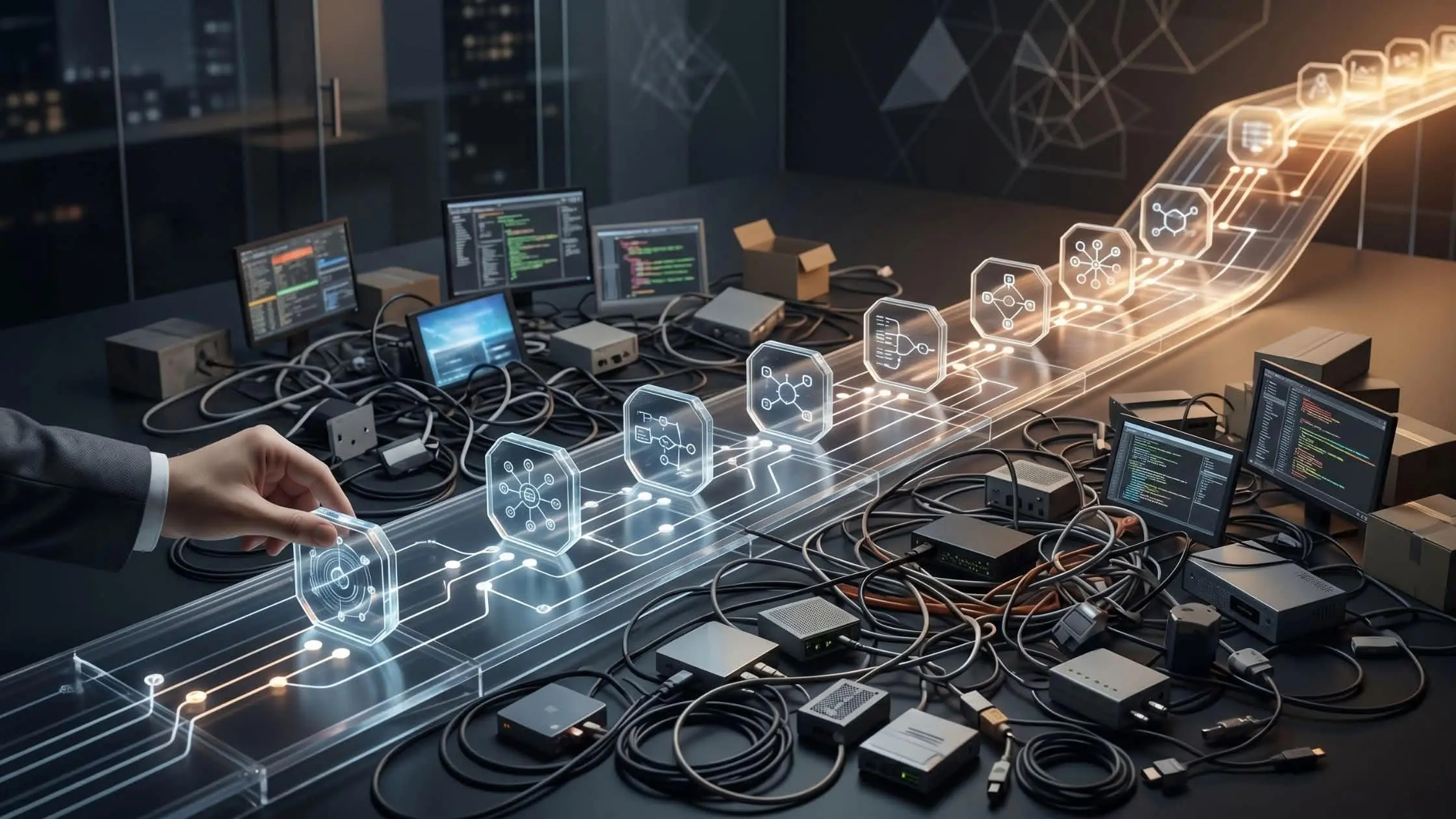
The contrast is sharp. In the first scenario, data migrates between software applications but sits waiting for a human decision at every station. In the second scenario, the system validates the data instantly upon arrival based on pre-set parameters, requiring zero manual intervention.
In a structure built on pure logic, the factual report of damaged goods automatically triggers the resolution. If the value of the damage falls below a specific threshold and the partner's status is clear, the system generates the replacement and alerts the warehouse without human deliberation. No internal chatting, no emails waiting for sign-off. The employee transitions from an investigator to a true decision-maker, stepping in only to handle extraordinary anomalies.
The number of manual decision points drops from five to zero.
The Freedom of Fewer Decisions
When management finally lets go of the reflex to buy another program and begins focusing on the internal logic of their processes, the mechanics of the company transform completely.
Fewer manual decision points do not equate to a loss of control. On the contrary, this is when control becomes real. The rules no longer exist merely inside managers' heads or scattered across documents; they become embedded into the very spine of the operations. The constant weight of micro-decisions and the fear of making a mistake are lifted from the team's shoulders.
This is the true source of indirect cost optimization. The company does not save money by down-sizing headcount or stripping away tools, but by eliminating the invisible downtime consumed day after day by waiting for information and approvals.
The Price of Technological Blindness
When corporate growth stalls, the biggest mistake leadership can make is expecting salvation from the IT department or a software vendor. Vendors sell tools because that is their job.
Structural problems, however, cannot be solved with a software license. Until internal information flows and decision-making mechanisms are ruthlessly audited, every new piece of software will simply act as another wall separating departments, driving further internal isolation.
The answers required to scale rarely hide within new technologies on the market. They are found through an objective, external process diagnosis capable of exposing the internal fault lines of the current operation.
The question remains: in the coming quarter, will the company pay for one more software license, or will it run one less unnecessary approval loop?